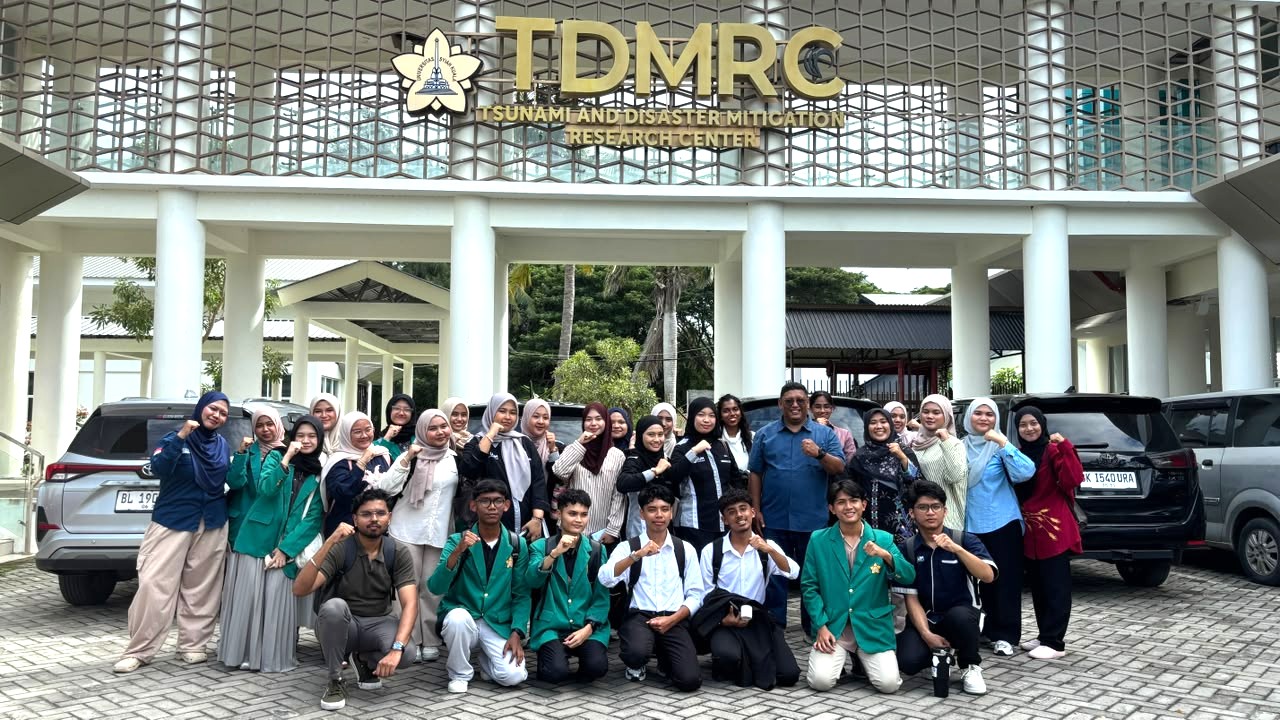

Banda Aceh – Students from Universiti Utara Malaysia (UUM) visited the Real-Time Earthquake Observatory, one of TDMRC USK’s disaster research facilities, on 12 November 2026 to broaden their knowledge of earthquake monitoring. 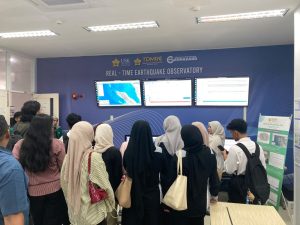
At the facility, visitors were introduced to real-time earthquake monitoring systems, seismic data recording mechanisms, and observation technology used to support rapid earthquake analysis. The observatory monitors global earthquake events 24 hours a day and is connected to seismometer stations from other countries, in addition to the network across Aceh Province. As of October 2025, TDMRC operated 12 online seismometer sensors across Aceh and more than 20 offline sensors. Together, these give researchers and students a close look at how earthquake data are captured, processed, and turned into information
Aceh was struck by the Indian Ocean earthquake and tsunami in December 2004, and the research center that houses the observatory was established on 30 October 2006 in the aftermath of that disaster; 2026 marks its 20th year. The observatory sits alongside other TDMRC facilities, including a Shaking Table, described as the first and largest of its kind in Southeast Asia, and a Tsunami Wave Flume. TDMRC has described these facilities as rare in the Indonesian context.
Visits like this open space for learning and cross-border collaboration in disaster mitigation. Earthquake and tsunami hazards do not stop at national borders, and sharing data, methods, and experience between universities in the region strengthens preparedness on both sides of the Strait of Malacca.
The visit supports several Sustainable Development Goals (SDGs). It contributes to SDG 4 (Quality Education) by giving students direct, hands-on exposure to earthquake science beyond the classroom. The observatory’s real-time monitoring and rapid analysis capabilities support SDG 9 (Industry, Innovation, and Infrastructure) by showing how observation technology and research infrastructure can be put to practical use. They also support SDG 11 (Sustainable Cities and Communities) by strengthening early warning and helping reduce the impact of disasters on people and cities. Finally, the cross-border exchange between UUM and USK advances SDG 17 (Partnerships for the Goals) by building academic ties that can grow into joint learning and research.