
Banda Aceh – Universitas Syiah Kuala (USK) hosted scientists, academics, practitioners, and policymakers from several countries at the 5th Annual Meeting of the Laboratoire Mixte International–Subduction and Associated Risks (LMI-SIR) Project.The international conference, themed “From Geohazard Science to Disaster Risk Reduction,” opened on the morning of Tuesday, October 27, 2026, at the Auditorium of the Faculty of Mathematics and Natural Sciences (FMIPA) USK in Banda Aceh.
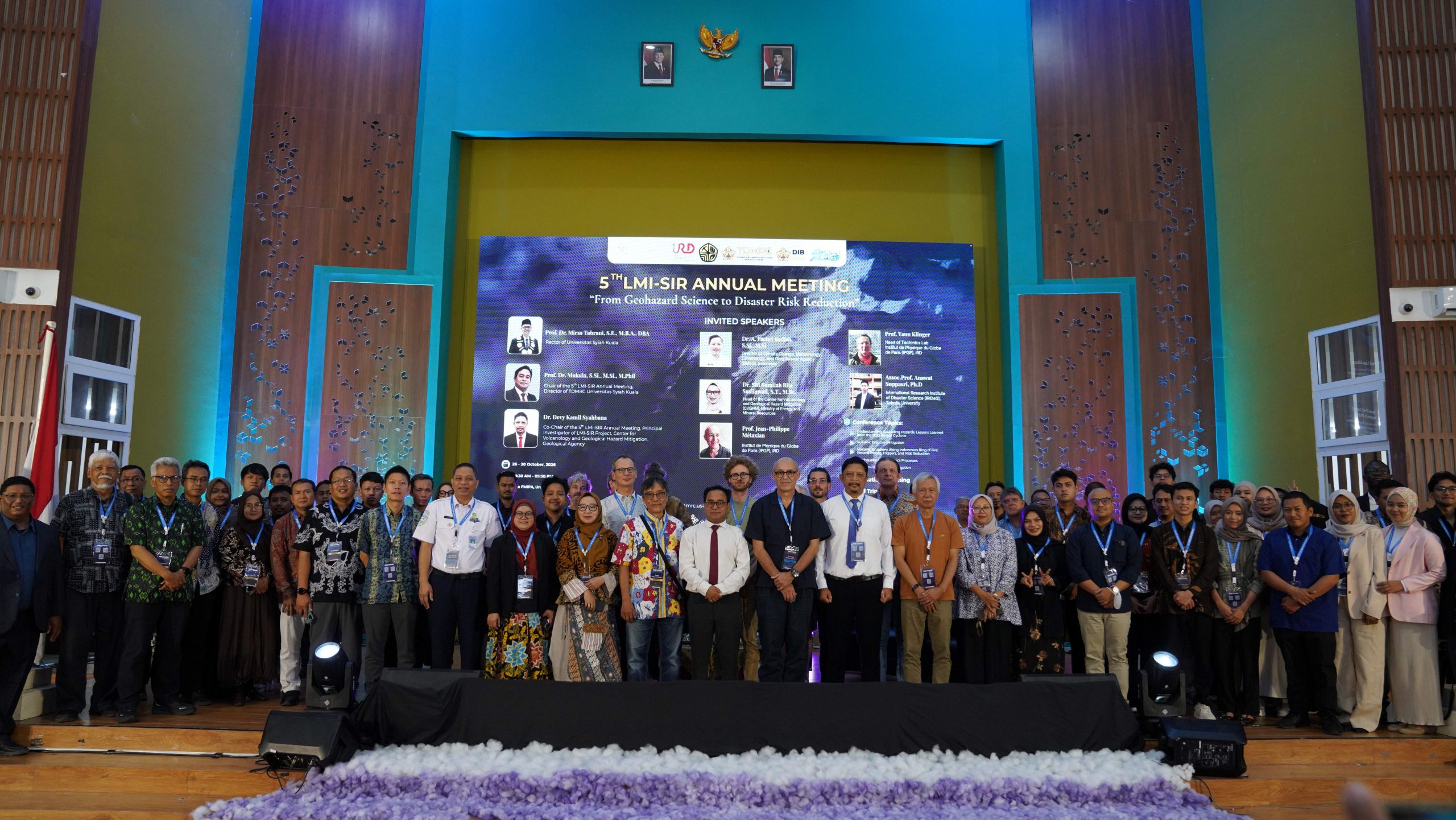
USK’s Vice Rector for Academic Affairs, Prof. Dr. Heru Fahlevi, SE, MSc, Ak, CA, officially opened the event on behalf of the Rector. Also present were Banda Aceh Mayor Illiza Sa’aduddin Djamal, SE; TDMRC USK head Prof. Dr. Muksin Umar, M.Si., M.Phil.; the Resident Representative of France’s Institut de Recherche pour le Développement (IRD) for Indonesia and Timor-Leste, Prof. Adèle Martial-Gros; and the Deputy for Systems and Strategy at Indonesia’s National Disaster Management Agency (BNPB), Dr. Abdul Muhari, S.Si., MT.
The opening began with a traditional ratoh jaroe dance and was marked symbolically by the beating of the rapai drum. The head of TDMRC USK then presented LMI-SIR’s progress and the direction of its future collaboration.
Registration data show the full series of activities drew 223 participants from ten countries: Indonesia, France, Japan, Kenya, the Philippines, India, Malawi, Sweden, Singapore, and Hungary. They included researchers, academics, students, disaster practitioners, and representatives of government agencies and research centers.
A total of 127 registrants joined the conference sessions. Organizers also received 44 abstracts: 32 were scheduled for oral presentation and 12 for scientific poster sessions.
Contribution to the Sustainable Development Goals (SDGs)
The conference is closely tied to several global goals:
- SDG 11 (Sustainable Cities and Communities): Research on subduction zones and their associated risks supports Target 11.5, which aims to reduce deaths and economic losses from disasters. This is especially relevant for Aceh, a region exposed to major earthquake and tsunami hazards.
- SDG 17 (Partnerships for the Goals): Collaboration among Indonesian institutions, France’s IRD, national agencies such as BNPB, and participants from ten countries reflects the science-sharing and multi-stakeholder partnerships promoted under Targets 17.6 and 17.16.
- SDG 9 (Industry, Innovation and Infrastructure): The scientific presentations and posters strengthen research capacity and innovation in geohazard science (Target 9.5).
- SDG 4 (Quality Education): Involving students, early-career researchers, and practitioners builds the knowledge and skills needed for disaster risk reduction.
