
Banda Aceh – The Tsunami and Disaster Mitigation Research Center at Universitas Syiah Kuala (TDMRC USK) held a multidisciplinary geohazards training on Monday, October 26, 2026. Geohazards are natural conditions, processes, or potential events originating within the Earth that can cause widespread destruction, property loss, and even deaths. Examples include earthquakes, volcanic eruptions, landslides, liquefaction, and tsunamis. The training, held at the TDMRC USK building in Banda Aceh, opened the 5th Annual Meeting of the LMI-SIR Project. The meeting continues through October 30 at the FMIPA USK Auditorium.
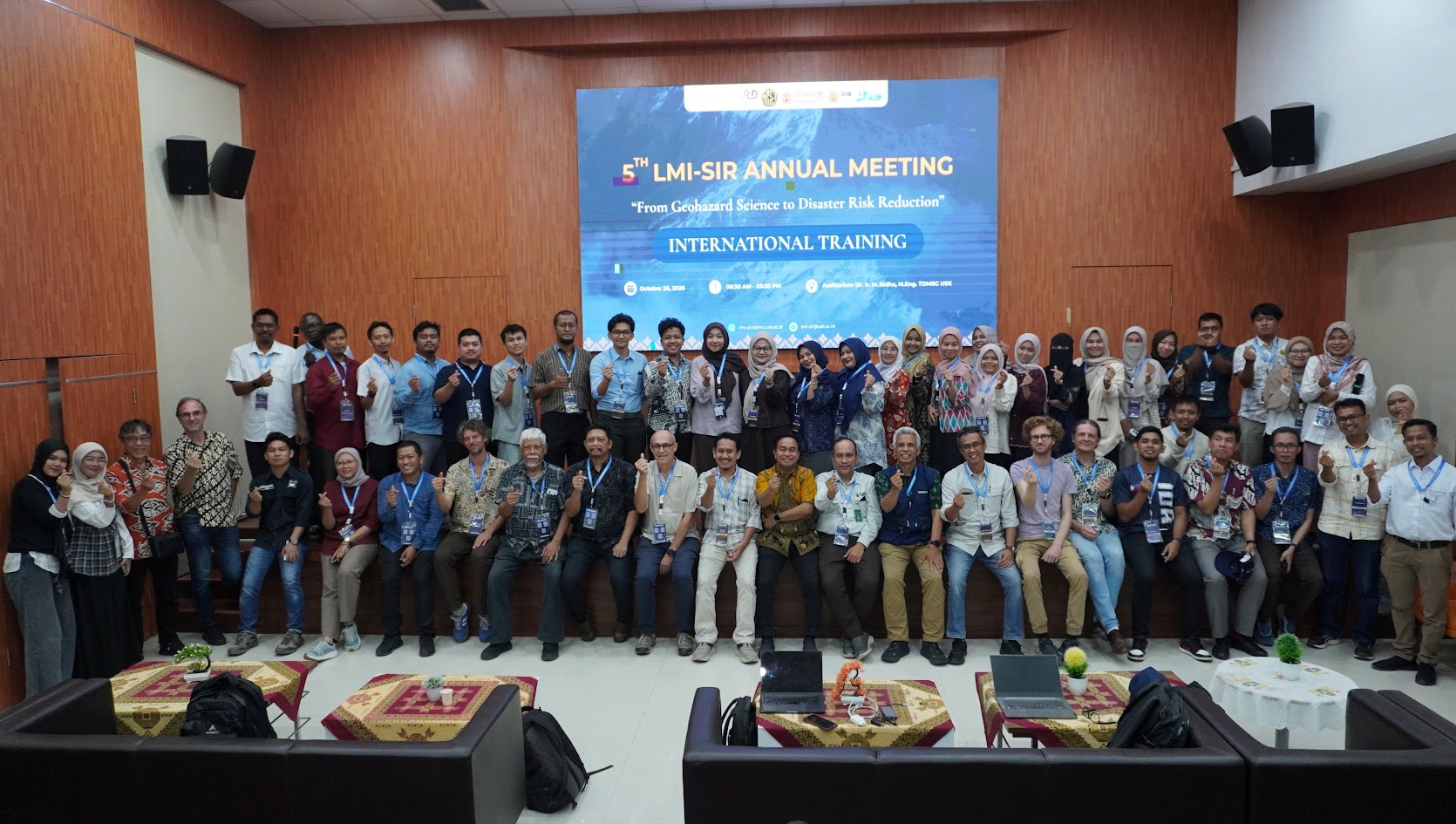
LMI-SIR (Laboratoire Mixte International – Subductions Indonésiennes et Risques associés) is a joint laboratory dedicated to understanding disaster risks linked to Indonesia’s subduction zones. It is funded by the French Institute of Research for Development (IRD). The event, themed “From Geohazard Science to Disaster Risk Reduction,” drew 223 participants from nine countries, including researchers, academics, students, practitioners, and representatives of disaster-focused organizations. Indonesia sent 206 participants and France 10. The Philippines, India, Malawi, Sweden, Singapore, Kenya, and Hungary each sent one.
The meeting aims to strengthen collaboration among researchers, academics, practitioners, policymakers, and national and international partners to advance disaster science and reduce disaster risk in Aceh and across Indonesia.
Organizers received 44 abstracts: 32 will be presented orally and 12 in poster sessions.
The first day was opened by TDMRC USK head Prof. Dr. Muksin Umar, M.Si., M.Phil. After a technical briefing, participants split into parallel training groups. Topics included:
- Using Distributed Acoustic Sensing (DAS) in early warning systems, led by Alister Trabattoni, PhD.
- Geological analysis methods for studying active faults, led by Dr. Gino de Gelder.
- Social anthropology approaches to geohazard research, facilitated by Alfi Rahman, PhD (TDMRC USK) and Dr. Muzayin Nazaruddin (Universitas Islam Indonesia, Yogyakarta).
Contribution to the Sustainable Development Goals (SDGs)
The activity is closely tied to several global goals:
- SDG 11 (Sustainable Cities and Communities): Better understanding of earthquakes, tsunamis, and other geohazards supports Target 11.5, which aims to reduce deaths, affected populations, and economic losses from disasters. This matters especially for Aceh, which sits near an active subduction zone.
- SDG 9 (Industry, Innovation and Infrastructure): Training in advanced sensing technology such as DAS, along with active fault analysis, advances scientific research and technological capability (Target 9.5).
- SDG 4 (Quality Education): Hands-on, multidisciplinary training builds the knowledge and skills that researchers, students, and practitioners need for disaster risk reduction.
- SDG 17 (Partnerships for the Goals): Cooperation between Indonesian institutions and France’s IRD, with participants from nine countries, reflects the knowledge-sharing and multi-stakeholder partnerships promoted under Targets 17.6 and 17.16.
