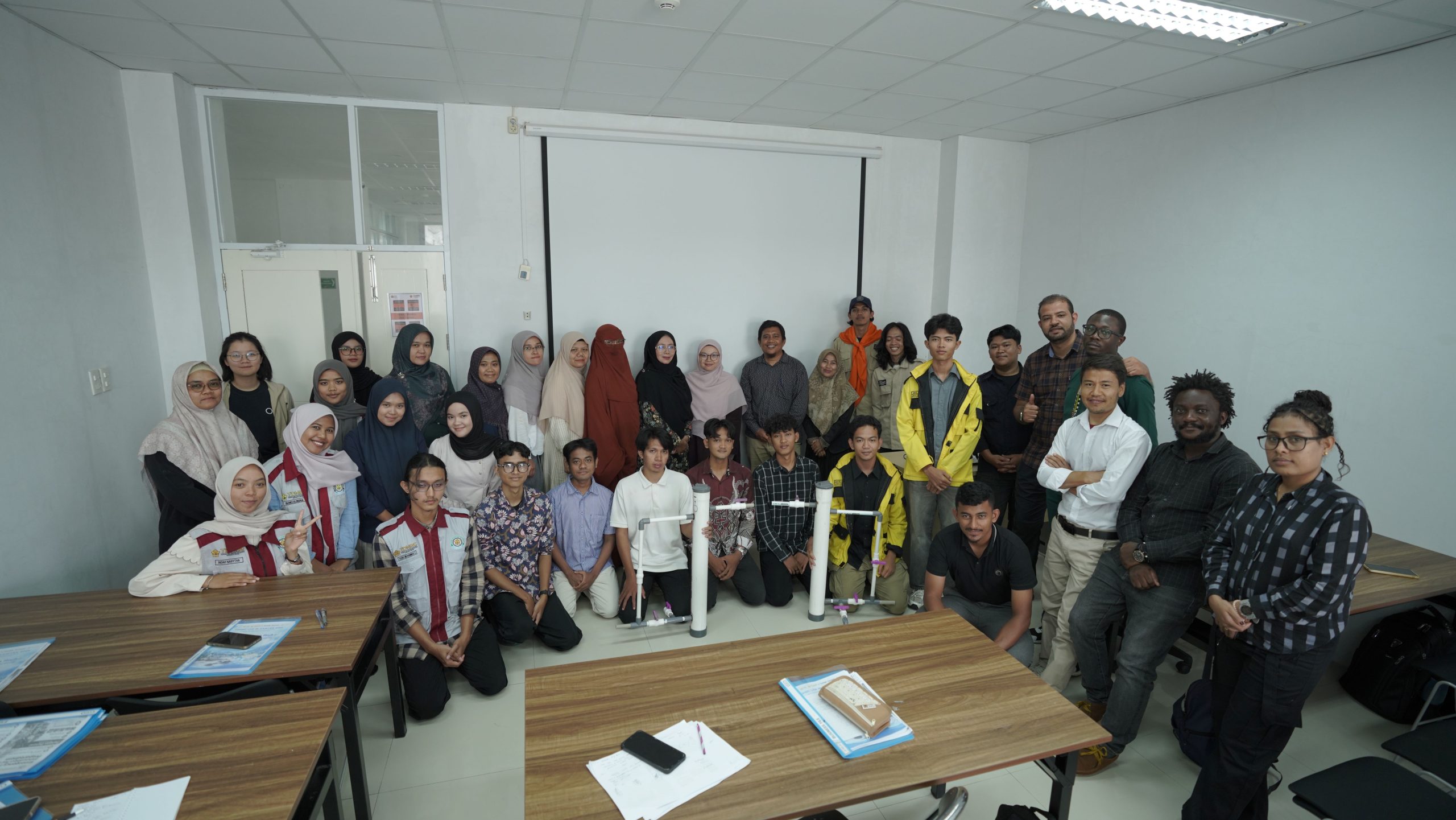

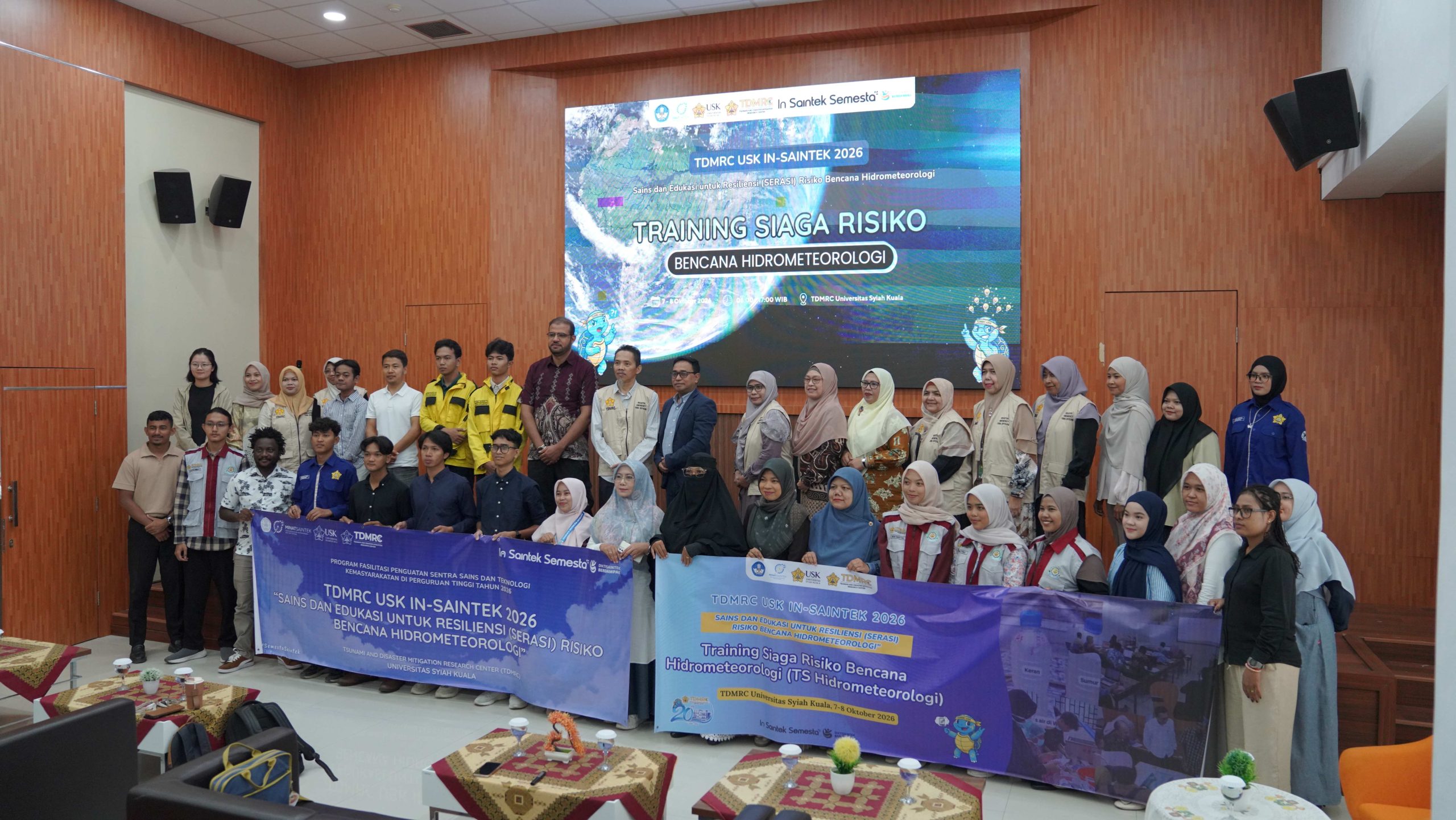
Banda Aceh, 08 October 2026 – On the second and final day of its hydrometeorological disaster preparedness training, the Tsunami and Disaster Mitigation Research Center at Universitas Syiah Kuala (TDMRC USK) trained participants in community-based flood early warning, WebGIS SINFRA-SENYAR, and emergency water filter making. The two-day training, held on 7 and 8 October 2026, is part of the TDMRC IN-SAINTEK 2026 Program, “Science and Education for Resilience (SERASI) on Hydrometeorological Disaster Risk.” It is supported by the Ministry of Higher Education, Science, and Technology through the Directorate General of Science and Technology. Local students, international students, and school teachers took part.
The program responds to Tropical Storm Senyar, which hit Sumatra in late November 2025 and caused deadly floods and landslides, and to the global rise in hydrometeorological disasters. Resource persons from the Indonesian Agency for Meteorology, Climatology, and Geophysics (BMKG) and TDMRC researchers gave participants an overview of hydrometeorological disasters. The sessions also looked at community-based flood early warning systems, which bring together information from several sources. Faqih Musyaffa, S.Tr.Met., M.Sc., said it is important to understand weather information and early warnings so people can act according to the threat they face.
“We need to understand weather information so we can use it as a basis for action. We hope participants can get information from official sources, recognize possible threats, and pass that information on correctly to the people around them,” Faqih said.
Participants also practiced making water filters, as part of preparing clean water after a disaster. TDMRC researchers said understanding the risks must go hand in hand with the skills to cope when basic needs, such as food and water, are disrupted.
“When a disaster happens, food and clean water become the main concerns. Practicing how to make emergency food and water filters gives participants a starting point to prepare for these needs. They still need to pay attention to food safety and water quality,” said Prof. Akhyar.
TDMRC USK Director Prof. Muksin hopes participants will share what they learned with others.
“We hope that what participants learn does not stay in the training room. They can share it on campus, at school, and in their neighborhoods, so more people know how to prepare for disasters,” Prof. Muksin said.
The training aims to build participants’ ability to adapt by improving their knowledge, technical skills, and data-based decision-making. Having students from different backgrounds together with school teachers also gives them a chance to share experiences that can help reduce disaster risk in their communities.